
When Pain Rewires the Spine: Breaking the Neuro-biomechanical "Wind-Up" Phenomenon
By: Shervin Ranjbar BSc MSc DC
Chronic pain is not simply a prolonged echo of an old injury; it is a progressive neurobiomechanical rewriting of how your central nervous system processes physical sensation. When soft tissue adhesions, fascial restrictions, or joint hypomobility persist, your spinal cord can experience the "wind-up" phenomenon. This pathological state of central sensitization causes the dorsal horn neurons in your spine to become hyper-responsive, turning mild mechanical pressure into agonizing pain signals.
To break this loop, successful recovery requires a collaborative, dual-modality approach combining advanced physical interventions and psychological therapies. At Near Me Therapy in Langley and Surrey, BC, our functional chiropractic care works directly to down-regulate hyperactive peripheral nerves by combining targeted joint mobilization with advanced soft tissue therapies, shockwave, laser, and functional movement retraining. Simultaneously, our clinical counselling services utilize evidence-informed cognitive strategies to quiet the brain's hyper-vigilant pain centers, helping patients systematically retrain their neural pathways for long-term recovery
The Neuro-biomechanics of the Wind-Up Phenomenon
When you suffer from persistent lower back stiffness, kinetic chain imbalances, or recurring tissue stress, local nociceptors (pain-sensing nerve endings) fire continuous warning signals to your spinal cord. Under normal circumstances, these signals subside as tissues heal. However, when altered movement patterns, restricted fascia, or joint dysfunction remain uncorrected, a cascade of physiological changes triggers the wind-up phenomenon.
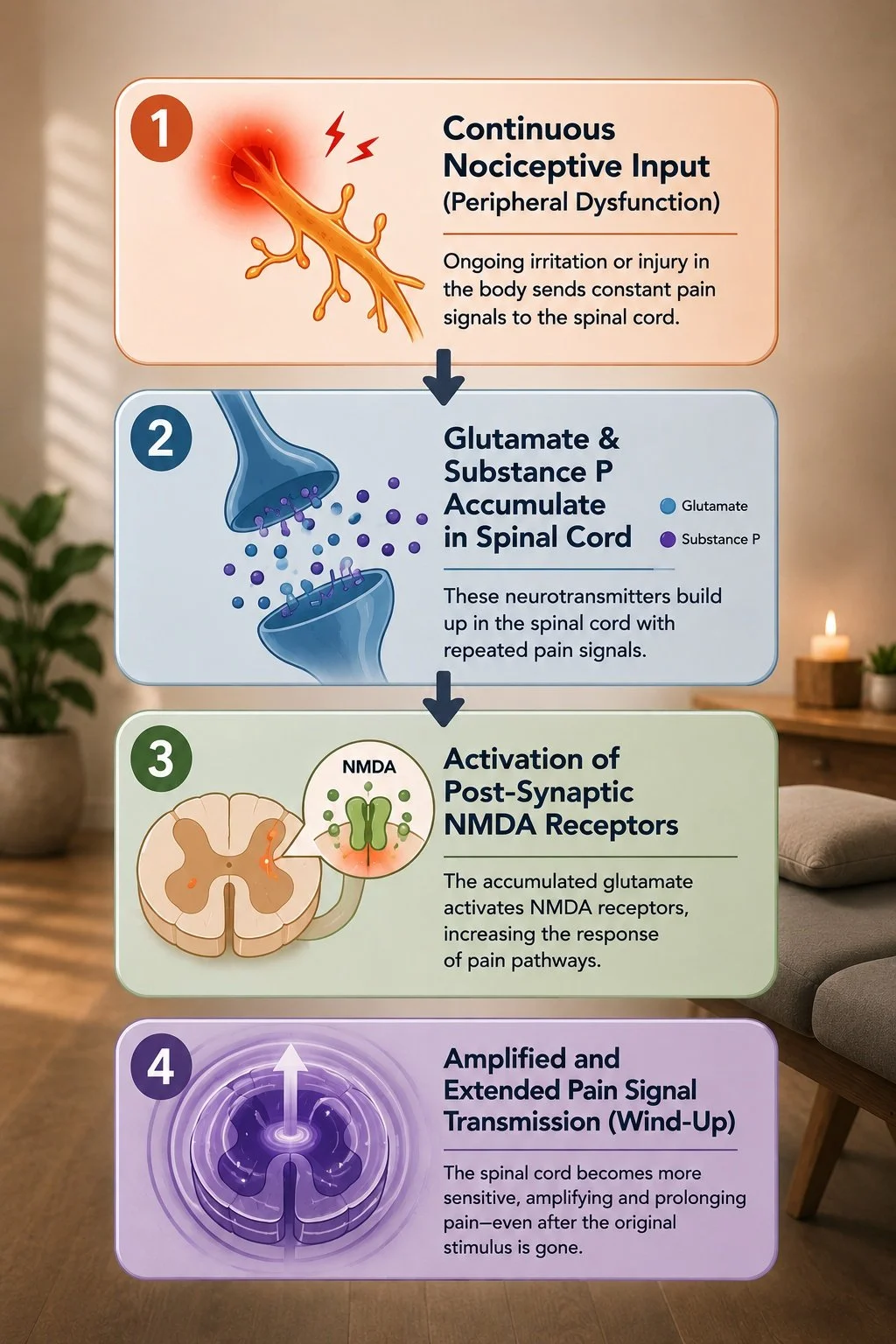
Figure 1: Pain Wind-Up Mechanism.
During this process, repetitive mechanical stress causes an accumulation of excitatory neurotransmitters, specifically glutamate and substance P, within the synapses of the spinal dorsal horn. This chemical buildup forces normally dormant N-methyl-D-aspartate (NMDA) receptors to open, allowing an influx of calcium ions that dramatically lowers the threshold for nerve activation.
The practical consequence is a highly sensitized nervous system operating in a state of constant over-drive. You begin to experience:
Hyperalgesia: An excessive, highly magnified response to a stimulus that is typically only mildly painful (like a firm palpation of the lumbar muscles).
Allodynia: A distressing state where completely non-painful stimuli—such as the light friction of clothing or a gentle therapeutic touch—are interpreted by your brain as sharp, burning discomfort.
The Biomechanical Reset: Modern Functional Chiropractic Care
Modern functional chiropractic care treats your musculoskeletal system as an interconnected kinetic chain. When we address chronic sensitization in the clinic, the intervention extends far beyond basic spinal alignment to target the joints, muscles, fascia, and neural pathways simultaneously.
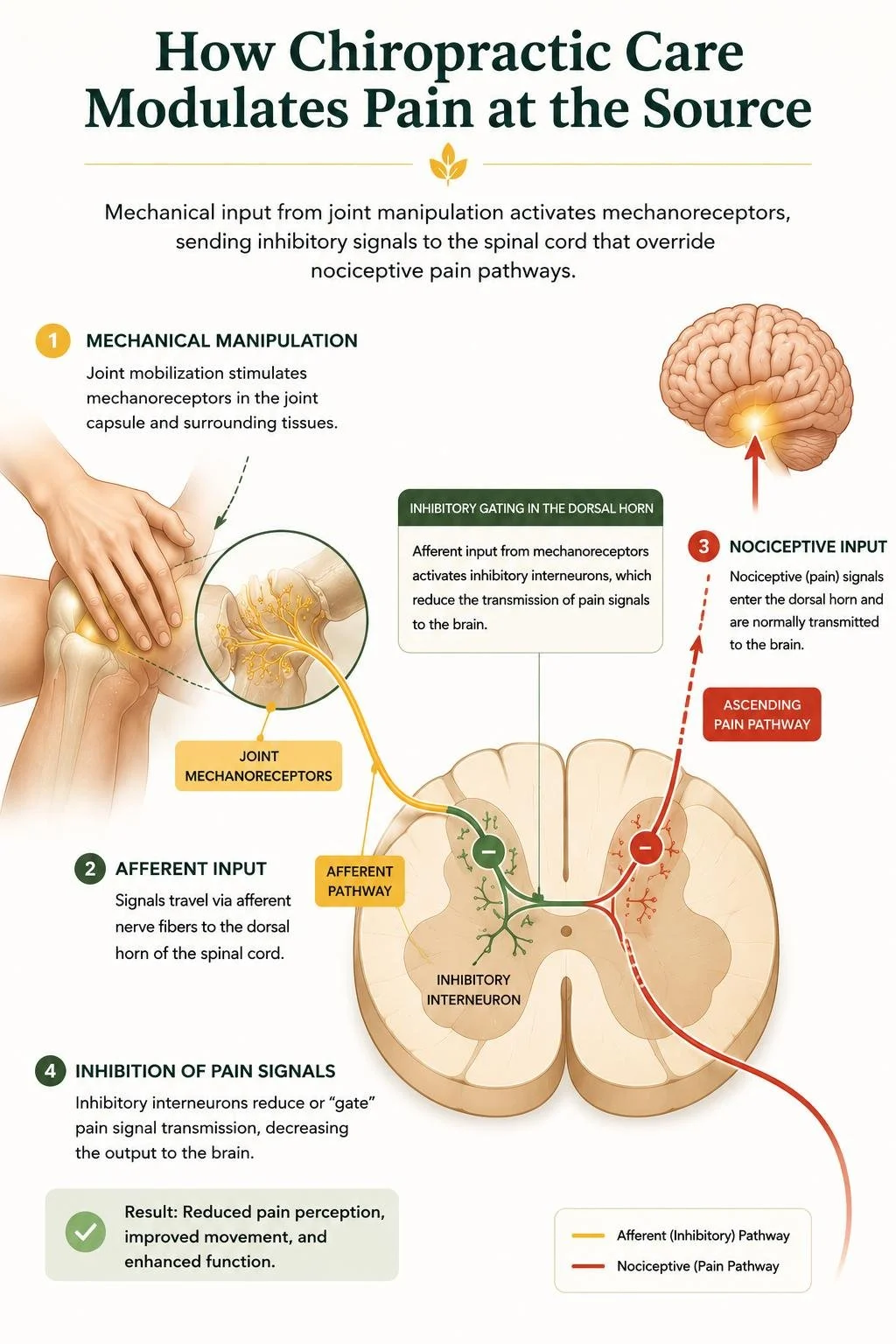
Figure 2
How chiropractic care may help modulate pain: mechanical stimulation of joint mechanoreceptors activates inhibitory pathways within the spinal cord, reducing nociceptive input and supporting improved movement, function, and recovery.
Soft Tissue, Fascia, and Joint Integration
Chronic wind-up causes the body to build protective muscular bracing patterns. We address this by integrating manual joint mobilization with targeted myofascial release therapy (MRT). Breaking up fascial restrictions and restoring slide-and-glide mechanics to hypertonic (overly tight) muscle groups removes the constant, low-grade peripheral nerve irritation feeding the spinal cord's dorsal horn.
Advanced Physical Modalities
To accelerate tissue healing and alter aberrant pain signaling, modern evidence-informed chiropractors utilize advanced clinical modalities directly on the injured structures:
Extracorporeal Shockwave Therapy: Delivers acoustic energy waves to chronically inflamed soft tissues, breaking down calcifications, stimulating angiogenesis (new blood vessel growth), and mechanosensitizing hyper-irritable nerve endings.
Photobiomodulation (Class IV Laser Therapy): Emits specific wavelengths of light to penetrate deep into tissues, accelerating cellular ATP production, reducing localized inflammatory cytokines, and soothing irritated peripheral nerves.
Therapeutic Kinesiology Taping: Provides continuous, low-load neurosensory input to the skin. This unloads inflamed dermal tissues, improves microcirculation, and alters proprioceptive feedback to the brain, helping to safely rewrite movement patterns.
Functional Motion and Exercise Retraining
The final, crucial element of this approach is movement re-education. Once joint mobility is restored and pain signaling is stabilized, we implement progressive loading exercises and functional motion drills. This resets the brain's altered motor maps, ensuring that everyday actions—like walking through Williams Park in Brookswood or commuting off Highway 1 in Willoughby—no longer trigger a protective pain response
The Neurological Control Room: Clinical Counselling and Central Regulation
While functional chiropractic medicine optimizes physical structures from the bottom up, clinical counselling addresses the central nervous system from the top down. Chronic pain is inextricably linked with the brain's emotional and threat-evaluation centers, including the amygdala, anterior cingulate cortex, and prefrontal cortex.
When a physical restriction or movement dysfunction persists for months, the brain naturally interprets this ongoing sensation as a threat to survival. This persistent state of alarm triggers a chronic sympathetic nervous system response ("fight-or-flight"), flooding the body with cortisol and adrenaline. This hormonal surge increases systemic inflammation and further sensitizes the spinal cord, accelerating the wind-up cycle.
Through specialized modalities such as Cognitive Behavioural Therapy (CBT) and Acceptance and Commitment Therapy (ACT), clinical counsellors help patients dismantle the psychological drivers of neurological wind-up:
Catastrophizing Interventions: Deconstructing subconscious thought patterns such as "This pain will never stop" or "My back is permanently broken." These fearful thoughts cause measurable spikes in amygdala activity, which directly amplifies physical pain perception.
Autonomic Regulation Strategies: Teaching evidence-informed diaphragmatic breathing, somatic tracking, and progressive muscle relaxation. These tools actively stimulate the vagus nerve, engaging the parasympathetic nervous system to lower the heart rate, reduce cortisol, and quiet the brain's hyper-vigilant focus on physical discomfort.
Near Me Therapy’s Integrative Wellness Model
True recovery from central sensitization cannot occur within isolated clinical silos. At Near Me Therapy, our practitioners operate as a cohesive, communicative healthcare team to offer families across Murrayville, Langley City, Walnut Grove, and Cloverdale a comprehensive path to lasting recovery.

Figure 3. Near Me Therapy's integrative rehabilitation model demonstrating how chiropractic, massage therapy, counselling, and kinesiology collaborate to support pain management, mobility, nervous system regulation, and long-term recovery in Langley, BC.
For instance, a patient recovering from a complex injury off the Fraser Highway may begin their care plan with gentle chiropractic joint mobilization and laser therapy to settle acute soft-tissue inflammation. Concurrently, they collaborate with a clinical counsellor to manage the underlying somatic anxiety and nervous system hyper-vigilance caused by chronic distress.
As the initial neurological wind-up begins to calm, the patient is smoothly transitioned to our Registered Massage Therapists (RMTs) to resolve deep tissue restrictions, and eventually to our kinesiologists for individualized active rehabilitation. This interdisciplinary approach ensures that every aspect of your recovery supports the next, laying the groundwork for a safe, pain-free return to regular daily activities.
References
Woolf, C. J. (2011). Central sensitization: Implications for the diagnosis and treatment of pain. Pain, 152(3), S2-S15. Access via PubMed
Graven-Nielsen, T., & Arendt-Nielsen, L. (2010). Assessment of mechanisms in localized and widespread musculoskeletal pain. Nature Reviews Rheumatology, 6(10), 599-606. Access via Nature
Coronado, R. A., et al. (2012). Changes in pain sensitivity following spinal manipulation: A systematic review and meta-analysis. Journal of Electromyography and Kinesiology, 22(5), 752-767. Access via ScienceDirect
Goertz, C. M., et al. (2018). Effect of Usual Medical Care Plus Chiropractic Care vs Usual Medical Care Alone on Pain and Disability Among US Service Members With Low Back Pain: A Comparative Effectiveness Clinical Trial. JAMA Network Open, 1(1), e180105. Access via JAMA Network
Eccleston, C., et al. (2013). Psychological therapies for the management of chronic and recurrent pain in children and adolescents. Cochrane Database of Systematic Reviews, (12). Access via Cochrane Library
