
Tooth Regrowth, Explained: How the Science Works and What Researchers Are Actually Doing
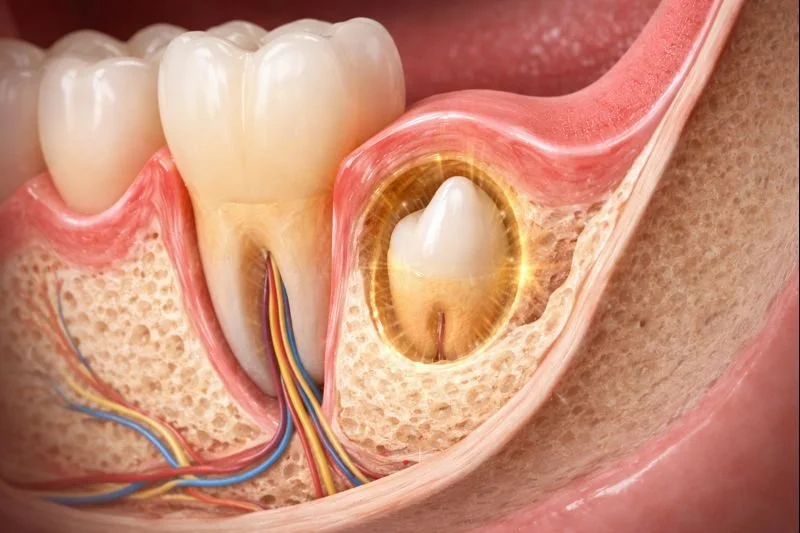
Potential tooth regrowth with TRG-035 Drug.
When people hear “tooth regrowth,” the first reaction is usually disbelief. Teeth are supposed to be permanent and once they’re gone, they’re gone. For decades, that was the assumption in dentistry.
What’s changed isn’t wishful thinking or viral headlines. What’s changed is a deeper understanding of how teeth form in the first place, and the discovery that the human body may still carry the biological instructions for making them.
This article focuses less on timelines and more on the science behind tooth regrowth: what researchers have discovered, how the current drug works, and why this approach is fundamentally different from anything dentistry has seen before.
Teeth Are Not Just “Hard Objects”
To understand tooth regrowth, it helps to first rethink what a tooth actually is.
A tooth isn’t just enamel stuck in bone. It’s a living structure that develops through a precise biological process involving:
Specialized cells
Growth signals
Timing cues
Interactions between bone, nerves, and soft tissue
During early development, these signals tell the body where a tooth should form, how big it should be, and when to stop growing. Once development is complete, those signals are largely shut down.
For years, scientists assumed those pathways disappeared entirely. They don’t.
The Key Discovery: Tooth Formation Is Actively Suppressed
One of the most important discoveries in this field was identifying that tooth development isn’t just “finished”. it’s actively prevented.
Researchers studying tooth formation found a protein called USAG-1. (1-2) Think of USAG-1 as a biological brake. Its role is to block growth signals involved in forming teeth after development is complete.
Those growth signals, especially pathways involved in tissue formation and repair, are still present in the body. USAG-1 simply keeps them turned off.
This matters because it re-frames the entire problem.
Instead of asking, “How do we create a new tooth from scratch?”, researchers began asking, “What happens if we release the brake?”
What Happens When the Brake Is Released?
In controlled laboratory and animal studies, scientists tested what would happen if USAG-1 was neutralized. (1-2)
When that suppression was lifted:
Dormant tooth-forming tissue resumed activity
Arrested tooth buds continued development
In specific cases, new tooth structures formed
This wasn’t random growth. It followed recognizable developmental patterns, guided by the body’s existing biological blueprint.
That distinction is critical. This research is not about forcing the body to grow something unnatural. It’s about allowing a natural process already encoded in the body to proceed under very specific conditions.
The Drug Approach: Supporting Biology, Not Replacing It
The drug currently being tested in humans, known as TRG-035, is designed to temporarily block USAG-1. (2)
It does not:
Add foreign tissue
Implant synthetic material
Use stem cells harvested from elsewhere
Instead, it works by modifying signaling in the body, allowing tooth-forming pathways to reactivate if the conditions are right.
That makes this approach fundamentally different from traditional dental solutions like implants or bridges, which replace missing teeth mechanically rather than biologically.
Why This Isn’t “Grow-a-Tooth Overnight” Science
One of the most important things to understand is that biology is slow by design.
Tooth development involves many factors including cell and tissue organization, blood and nerve integration and maturation of the tissue. Even in natural childhood development, teeth take years to fully form and erupt. Regenerative approaches will follow the same biological rules.
This is why current research will be focuses heavily on, safety, dose control and predictability.
Researchers are not trying to rush outcomes. They are trying to understand how the system responds when these pathways are adjusted.
Why the Surrounding Environment Matters So Much
Another key insight from this science is that teeth don’t develop in isolation.
Successful tooth formation depends on:
Healthy bone
Stable gum tissue
Adequate blood supply
Functional nerve signaling
Controlled inflammation
Balanced mechanical forces
If those conditions aren’t present, the biological signals alone may not be enough.
This is why researchers—and forward-thinking clinicians—emphasize the environment just as much as the signal.
Regenerative dentistry doesn’t override the body’s condition. It depends on it.
What Human Trials Are Really Studying
Current human trials are carefully designed to observe:
How the drug behaves in the body
Whether it triggers unwanted immune responses
Whether tooth-forming activity can be detected safely
At this stage, researchers are not promising full tooth regrowth. They are validating whether this biological mechanism can be engaged without harm.
That cautious approach is a strength, not a limitation.
Why This Research Is Taken Seriously
This work isn’t coming from fringe sources or unregulated clinics. It is rooted in:
Peer-reviewed research
University-based science
Formal regulatory oversight
The reason tooth regrowth is now discussed seriously is because it has passed an important threshold: it is mechanistically plausible and experimentally supported.
That doesn’t mean it will work for everyone. But it does mean the question has shifted from “Is this real?” to “How far can this go?”
What This Means for Dentistry Going Forward
Even if regenerative tooth therapies become available in the future, they are unlikely to replace existing care.
Instead, they may:
Expand options for specific patients
Complement restorative dentistry
Increase the importance of prevention and tissue health
Shift dentistry further toward biological support rather than replacement
In other words, regeneration doesn’t make oral health less important. It makes it more important.
The Takeaway
Tooth regrowth research isn’t about shortcuts or miracle cures. It’s about understanding how the body already works and learning how to support those systems responsibly.
The science shows that:
Tooth-forming pathways still exist
They are actively regulated, not erased
Carefully adjusting those signals may allow biological repair in select situations
Whether or not regenerative dentistry becomes part of everyday care, one message is already clear:
Teeth are part of a living system. And treating them that way changes everything.
Are you taking care of your mouth so you remain a candidate for innovative solutions like tooth regrowth in the future? Book an assessment with our expert and highly experienced dental hygiene professionals to improve your oral health journey today!
References
1. Murashima-Suginami A, Kiso H, Tokita Y, et al. Anti-USAG-1 therapy for tooth regeneration through enhanced BMP signaling. Sci Adv. 2021;7(7):eabf1798. Published 2021 Feb 12. doi:10.1126/sciadv.abf1798
2. Takahashi K, Kiso H, Mihara E, Takagi J, Tokita Y, Murashima-Suginami A. Development of a new antibody drug to treat congenital tooth agenesis. Journal of Oral Biosciences. 2024;66(4):1-9. doi:10.1016/j.job.2024.10.002. USAG-1 neutralizing antibodies show promise for restoring tooth formation and are progressing toward clinical trials.
