
Why is My Jaw Clicking on One Side? | Near Me Therapy Langley
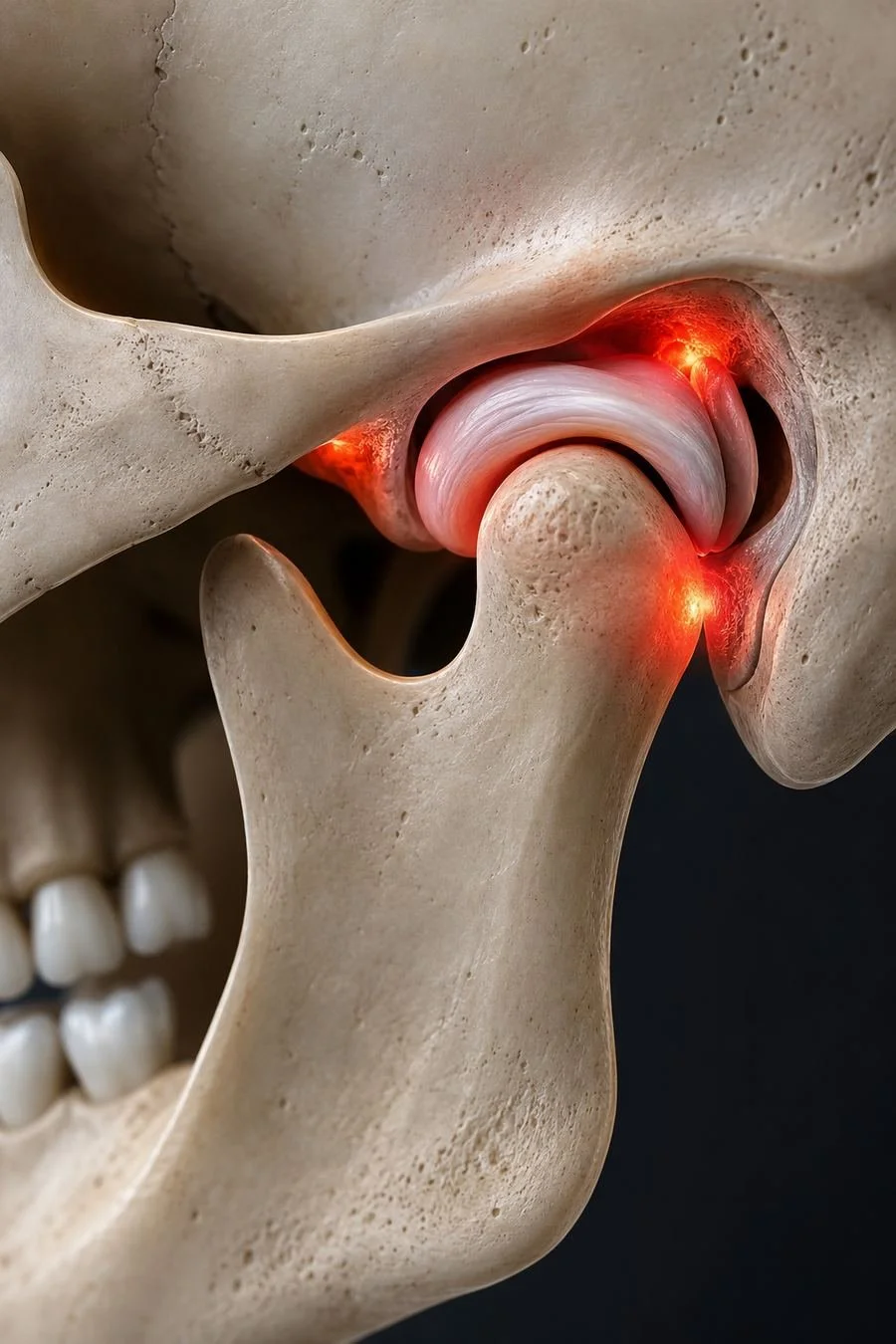
Fig 1: Asymmetrical mechanical stress and muscle hypertonicity leading to unilateral TMJ disc displacement.
Jaw clicking on one side—clinically identified as Temporomandibular Joint (TMJ) disc displacement with reduction—is a mechanical failure where the articular disc, a cartilaginous cushion, slips out of alignment and "pops" back into place during movement. For residents in Langley and Surrey, this unilateral clicking is rarely an isolated jaw issue; it is typically a symptom of asymmetrical muscle hypertonicity or postural compensation. At Near Me Therapy, we treat this by addressing the "why": often, the lateral pterygoid muscle becomes overactive, dragging the disc forward so the mandible must "jump" over it to open the mouth. This mechanical hitch is frequently exacerbated by long commutes on Hwy 1 or repetitive clenching habits developed during high-stress shifts in Cloverdale.
The Anatomy of the "Click": Physical Realism
To understand why only your left or right side is clicking, you have to visualize the joint's movement. Your TMJ is not a simple door hinge; it is a sliding-gliding joint.
Between your jawbone (mandible) and your skull sits a dense, fibrous disc. This disc is supposed to move in tandem with the bone to prevent friction. When you hear a "click," you are witnessing a three-stage mechanical error:
The Displacement: Due to muscle tension, the disc is pulled too far forward (anteriorly) while your mouth is closed.
The Obstruction: As you begin to open, the jawbone hits the back edge of the displaced disc rather than sitting centered on it.
The Reduction: You feel a "thud" or hear a "click" as the jawbone finally forced itself under the disc, "reducing" the displacement.
When this happens on only one side, it indicates a structural asymmetry. Your nervous system is likely favoring one side for chewing or compensating for a tilt in your upper cervical spine (the neck).
The Local "Kinetic Chain": From Hwy 1 to the Jaw
In our practice serving Willoughby and Walnut Grove, we rarely see a jaw issue that doesn't involve the neck and shoulders.
The "Forward Head" Pull: Many patients commuting through the Langley corridor develop "Upper Cross Syndrome." As the head drifts forward toward a steering wheel or computer screen, the muscles under the chin (suprahyoids) stretch tight, pulling the jaw backward. This forces the TMJ into a cramped position where the disc is easily squeezed out of place.
Asymmetrical Loading: If you habitually lean your jaw on your hand while reading or use a shoulder to prop up a phone, you are physically shoving the mandible into the joint space on one side. This thins the cartilage and overstretches the ligaments that are supposed to keep the disc stable.
The Feeling of Dysfunction: Muscle and Nerve
It isn't just a sound; it’s a sensory experience. You may feel a "fullness" in the ear, often mistaken for an ear infection. This occurs because the TMJ sits millimeters away from the auditory canal. When the joint is inflamed, the auriculotemporal nerve fires off signals that the brain interprets as deep ear pain.
If you place your fingers just in front of your ear holes and open wide, you might feel one side "swing" out further or faster than the other. This is called deviation. The clicking side is struggling to find its rhythm, leading to the masseter muscle (your primary chewing muscle) feeling like a hard, knotted cord of wood rather than soft tissue.
Integrative Solutions: Restoring Symmetry
At Near Me Therapy, we move beyond the joint to treat the entire functional unit.
Registered Massage Therapy (RMT) & Physical Realism
Our RMTs focus on Intra-oral Release. By applying clinical pressure to the medial pterygoid and buccinator muscles from inside the mouth, we can manually "reset" the tension holding the jaw crooked. You will feel a specific, intense release as the muscle fibers—which are often stuck in a state of micro-contraction—finally lengthen.
Kinesiology & Postural Realignment
The jaw follows the head. Our Kinesiologists work on the deep cervical flexors of the neck. By strengthening the muscles that keep your head stacked over your shoulders, we take the mechanical "brake" off your jaw, allowing the disc to glide without getting snagged.
Acupuncture & Neural Modulation
Acupuncture is used to target the lateral pterygoid, a deep muscle that is nearly impossible to reach with manual therapy alone. By inserting a needle into the motor point of this muscle, we create a local twitch response that forces the muscle to drop its "guard," allowing the disc to slide back into its natural groove.
Dental Hygiene & Occlusal Assessment
Your "bite" is the final stop for your jaw. If your teeth don't meet evenly, your jaw will shift every time you swallow (which happens about 600 times a day). Our dental hygiene team assesses wear facets on your enamel—flat, shiny spots that prove you are grinding through the night—providing the evidence needed to determine if a nightguard is necessary to protect the joint.
When Should You Be Concerned?
A click that is painless is often a "yellow light"—a warning that the mechanics are failing. However, if the clicking stops and is replaced by an inability to open your mouth fully (a "closed lock"), the disc has likely become a physical wedge blocking the joint.
Addressing the muscular "tug-of-war" now at our Langley/Surrey clinic ensures that a simple click doesn't progress into chronic degenerative change.
References
AAFP. (2023). Temporomandibular Disorders: Rapid Evidence Review. American Family Physician. https://www.aafp.org/pubs/afp/issues/2023/0100/temporomandibular-disorders.html
Garstka, A. A., et al. (2023). Accurate Diagnosis and Treatment of Painful Temporomandibular Disorders. Pain Research and Management. https://doi.org/10.1155/2023/1002235
Li, D. T. S., & Leung, Y. Y. (2021). Temporomandibular Disorders: Current Concepts and Controversies. Diagnostics. https://doi.org/10.3390/diagnostics11030459
Poluha, R. L., et al. (2019). Temporomandibular joint disc displacement with reduction: a review of mechanisms. Journal of Applied Oral Science. https://doi.org/10.1590/1678-7757-2018-0433
Prodoehl, J., et al. (2022). Effect of Starting Posture on Three-Dimensional Jaw and Head Movement. Journal of Oral and Maxillofacial Research. https://doi.org/10.5037/jomr.2022.13104
StatPearls. (2023). Temporomandibular Syndrome. StatPearls - NCBI Bookshelf. https://www.ncbi.nlm.nih.gov/books/NBK551612/
