
The Cervicogenic Connection: Why Your Headaches Might Be a Neck Problem
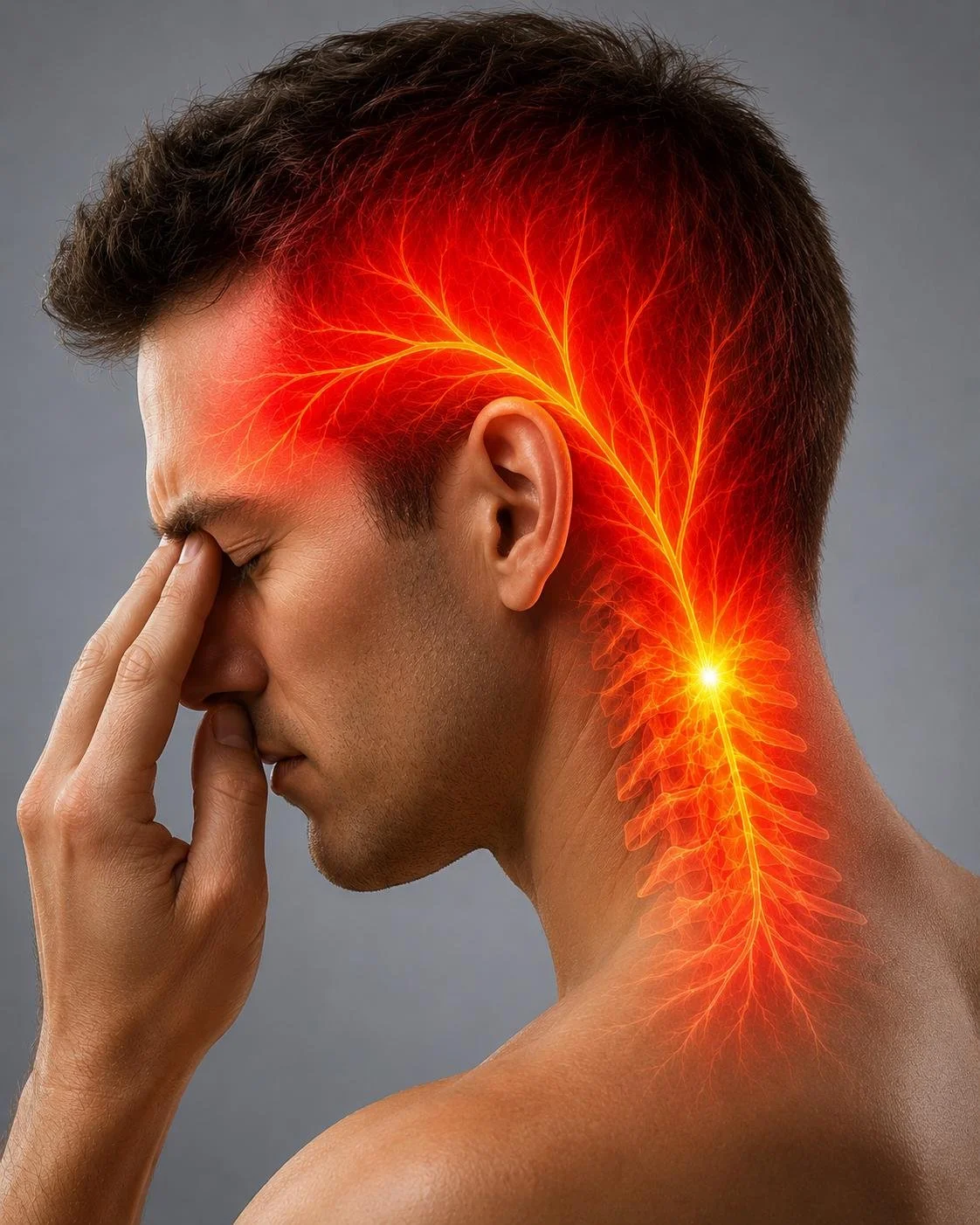
Many people in Langley and Surrey who suffer from chronic head pain mistake it for a standard migraine or tension headache. However, a significant portion of these cases are actually cervicogenic headaches—referred pain originating from structural dysfunctions in the upper cervical spine and neck musculature.
When joints between the C1, C2, and C3 vertebrae become misaligned or restricted, they compress local nerves, triggering a pain loop that travels upward into the head. Concurrently, hypertonic neck muscles develop micro-tears and trigger points, compounding this discomfort.
To resolve this, an integrative approach combining Chiropractic care and Registered Massage Therapy (RMT) is highly effective. Chiropractors utilize precise cervical adjustments to restore vertebral alignment and decompress neural pathways. Meanwhile, RMTs apply targeted myofascial release to reduce muscle hypertonicity and restore normal tissue elasticity. Addressing the mechanical root in the neck provides long-term relief rather than temporary symptom management.
The Anatomy of Referred Pain: How the Neck Mimics a Headache
To understand why a neck issue feels like a throbbing pain behind your eyes or a tight band around your skull, we must look at the nervous system's wiring. The upper three cervical nerve roots (C1, C2, and C3) share a common pain-processing pathway with the trigeminal nerve—the primary nerve responsible for sensation in your face and head. This anatomical convergence point in the spinal cord is known as the trigeminal cervical nucleus.
The diagram above illustrates this neurological cross-wiring. When a joint in your upper neck is restricted, or a deep suboccipital muscle is chronically spasmed, sensory neurons send distress signals down the cervical spinal nerves. These signals arrive at the trigeminal cervical nucleus, where they converge with sensory fibres arriving from the face and forehead.
Because these pathways intersect so closely, the brain experiences a form of sensory confusion. It misinterprets the incoming noxious stimuli from the neck, projecting the sensation of pain forward into the forehead, temple, or orbital socket. This is the physiological mechanism of referred pain; the source of the pathology is entirely cervical, but the conscious perception of pain is cranial.
Physical Realism: What Cervicogenic Headaches Feel Like
Unlike neurovascular migraines, which are often preceded by visual auras or nausea, cervicogenic headaches are strictly mechanical. Patients visiting our clinic often describe a distinct set of physical behaviors and sensations:
The "Ram's Horn" Pattern: Pain typically begins as a dull ache at the base of the skull (the occiput) and slowly sweeps forward over the top of the ear to the temple or forehead, usually strictly on one side.
Deep Suboccipital Hardness: If you press your thumbs into the soft dip just beneath the skull base, the tissue feels as rigid as bone. These are the suboccipital muscles, locked in a state of ischemic contraction.
Postural Aggravation: The pain intensifies after specific behaviors—such as staring up at a menu board in Fort Langley, sitting in gridlock on Highway 1 during the evening commute, or hunching over a laptop at a desk in Willoughby.
Restricted Rotation: Turning your head to check your blind spot while driving down the Fraser Highway feels restricted, sharp, or tightly bound on one side.
The Local Catalyst: Driving and Working in Langley & Surrey
Geography and modern lifestyle play a massive role in cervical health. We see a high concentration of these headaches in residents commuting from communities like Brookswood, Walnut Grove, and Cloverdale. Long commutes mean hours spent with the head shifted forward and hands tense on the steering wheel. Similarly, remote workers in the business hubs of Langley City spend hours in poorly optimized workstations.
When your head shifts forward by even one inch, the effective weight of your head on your cervical spine doubles. The deep stabilizing muscles of your neck exhaust themselves trying to hold your head up, eventually developing trigger points—areas of localized muscle spasm deprived of proper blood flow.
The Integrative Solution: How Chiropractic and RMT Work Together at Near Me Therapy
Managing cervicogenic headaches effectively requires treating both the hard frame (the joints) and the soft tissue (the muscles). This is where the cross-disciplinary partnership between evidence-informed Chiropractic care and Registered Massage Therapy (RMT) becomes vital for complete clinical resolution.
The anatomical chart highlights the relationship between the skeletal structures and the overlaying muscular layers. The upper cervical spine possesses a high density of mechanoreceptors and small, specialized tracking muscles like the rectus capitis and obliquus capitis groups. When joint fixation occurs at the C1-C3 levels, these deep muscle layers instantly hyper-tone to guard the joint, creating a restrictive anchor that perpetuates nerve irritation.
To break this cycle, our Chiropractors first evaluate the specific motion of these cervical vertebrae, applying controlled, precise mobilizations or when indicated, adjustments to fixated segments to reduce mechanical stress on the joint capsules. This spinal decompression immediately allows our Registered Massage Therapists (RMTs) to work deeper into the soft tissue without triggering defensive muscle guarding. The RMT then targets the hypertonic suboccipitals and upper trapezius using myofascial release, flushing metabolic waste and restoring tissue elasticity.
By restoring skeletal mobility via chiropractic adjustments, the targeted massage therapy lasts significantly longer; conversely, by releasing the muscular tension first, the chiropractic adjustments require less force and hold their alignment far better.
Evidence-Informed Care for Long-Term Resolution
Clinical guidelines consistently show that manual therapy is highly effective for managing cervicogenic headaches. Landmark research demonstrates that a combination of spinal manipulation and specialized soft tissue therapy results in a significant reduction in both headache intensity and frequency compared to medication alone.
At our clinic, we do not rely on passive, temporary fixes. Once your Chiropractor and RMT have jointly restored joint mobility and reduced muscle hypertonicity, we seamlessly integrate exercise plans and include our Kinesiology team into your recovery plan. Our Kinesiologists design active rehabilitation protocols to strengthen your deep neck flexors—the core muscles of your neck. This comprehensive, multi-disciplinary transition ensures your body can maintain its structural alignment, whether you are driving through Murrayville or sitting at a desk all day. If you are tired of relying on pain medication to cope with your headaches, it is time to look at the structural foundation. Your head pain might simply be your neck asking for help.
References
Bodes-Pardo, G., et al. (2013). Manual treatment for cervicogenic headache: A systematic review. Journal of Manipulative and Physiological Therapeutics, 36(6), 384-392. (This study validates that combining joint mobilization with myofascial therapy yields superior outcomes for reducing cervical headache frequency).
Bogduk, N., & Govind, J. (2009). Cervicogenic headache: an assessment of the evidence on clinical diagnosis and treatment. The Lancet Neurology, 8(10), 959-968. (This literature establishes the neurological pathway of the trigeminal cervical nucleus and confirms how upper cervical spinal nerves refer pain to the forehead and ocular regions).
Page, P. (2011). Cervicogenic headache: an evidence-led approach to clinical management. International Journal of Sports Physical Therapy, 6(3), 254-266. (This paper highlights the efficacy of addressing forward head posture and muscle imbalances to resolve chronic cervical spine stress).
